



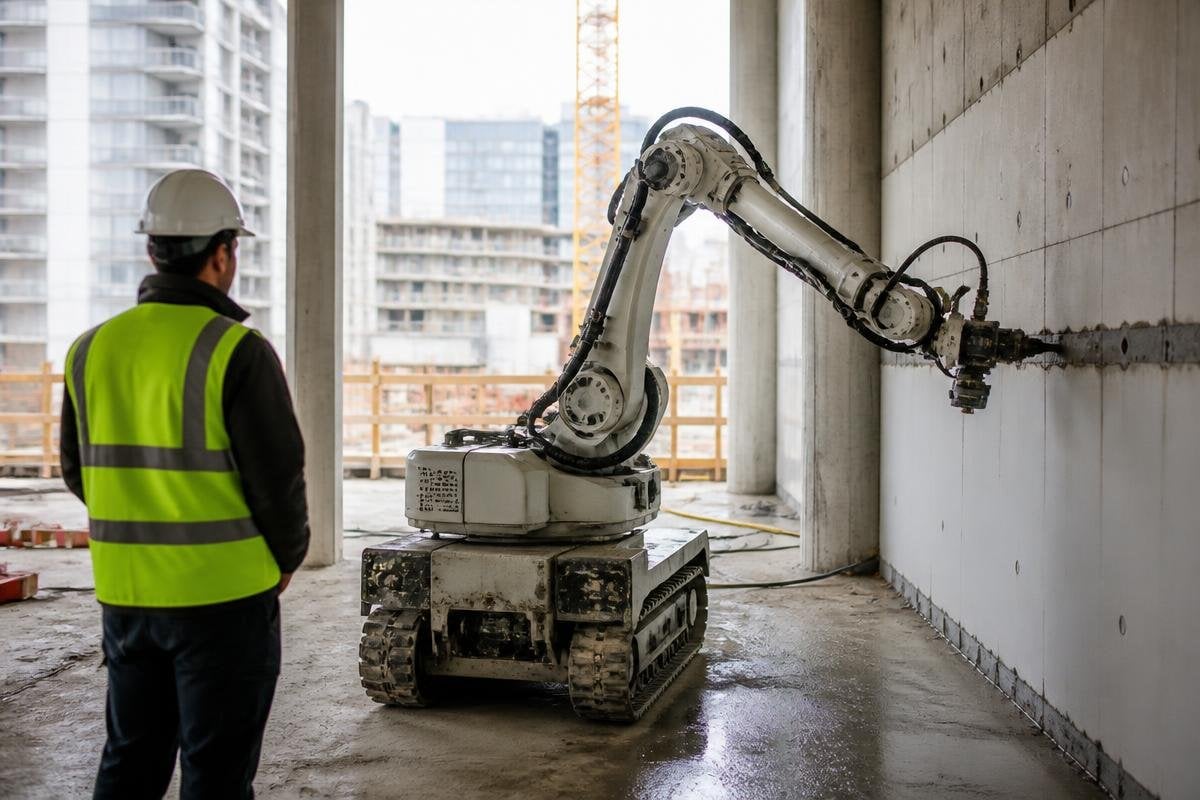
Construction robotics is often described as ready for a wider market, but the supplied evidence gives no project count, price, date, or measured result to prove that shift. For a contractor choosing equipment, the useful question is narrower: can a robot complete one paid task often enough to cover its cost?
- Ask for a measured task result, not a demo clip
- Check the full cost of setup, supervision, service, and repair
- Test the robot against the site conditions you actually have
The job comes before the robot
A construction robot has to fit a task with clear steps and a repeatable result. That may involve moving material, placing components, scanning a site, cutting a part, or handling work in a risky area. The task matters more than the robot’s shape.
The buyer needs a short answer to four practical points: what goes in, what the robot does, what comes out, and how often the cycle works. If the vendor can’t state those points with measured results, the project is still at the trial stage.
Construction sites add problems that factory floors can avoid. Ground changes, weather shifts, nearby workers, temporary power, and unfinished structures can all affect a robot’s work. A machine that runs well in a controlled bay may need extra setup each morning on a live site.
Why the timing may be changing
The topic suggests that construction robotics is reaching a wider stage of use, yet no source in the brief explains why. A sound report would need dated evidence from named projects, such as the number of machines in use, the task completed, the hours worked, and the result compared with the usual method.
Price matters just as much. A robot’s purchase price is only one part of the bill. You also need the cost of transport, site setup, operator time, software, safety checks, charging, spare parts, and downtime. A lower labor need can still produce a poor result if the robot spends too much time waiting for the site to be ready.
A construction robot’s payback claim means little without a named project, measured task rate, and service record. Construction robotics reporting from Robot24.com can tie those figures to site conditions and the human work around the machine. Those records give the next section something firm to test.
The proof that should change your decision
The strongest evidence would connect one machine to one paid task. A useful case report would name the contractor, project, robot model, work period, task rate, crew size, and reason the team kept using the system.
A video can help you see the workflow, but it leaves major questions open. Look for the full work cycle, handoffs, pauses, safety stops, and the time needed to reset the machine.
A short clip may show that a robot can complete a task once. It doesn’t show whether the task works across a full shift.
The missing evidence matters because construction buyers carry the cost when a trial fails. I’d wait for a dated project record with operating hours and cost data before calling a system ready for broad use.
A practical buying checklist
Use these checks before a paid trial:
- Name the task: Write the exact work the robot must finish and the result that counts.
- Set the site limits: Record ground type, weather exposure, power, access, nearby people, and working height.
- Measure the cycle: Time setup, active work, pauses, resets, and moves between locations.
- Count the crew: Include the people who load, supervise, move, repair, and check the robot.
- Price the failure: Set a cost for downtime, damaged material, missed work, and extra site labor.
- Choose a stop rule: End the trial if the agreed task rate or cost target fails for a stated period.
That checklist turns a broad claim into a test a project manager can review. It also gives the vendor a fair target, since the same task and cost rules apply throughout the trial.
Construction robotics may be reaching a new stage, but the brief supplies no evidence to show how wide that use is today. The next useful proof is a named job site with a robot model, a measured task rate, total trial cost, and a result that holds after the cameras stop.